


This page is under construction - we apologize for any inconvenience!
If you have any questions or need access to a resource you can't find, please call the Planning office directly at 766 6410.
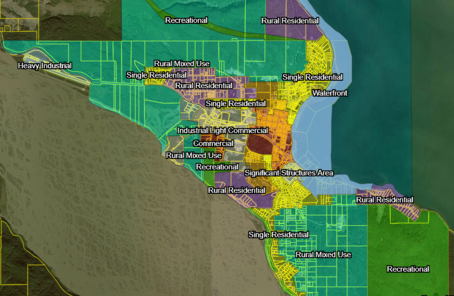



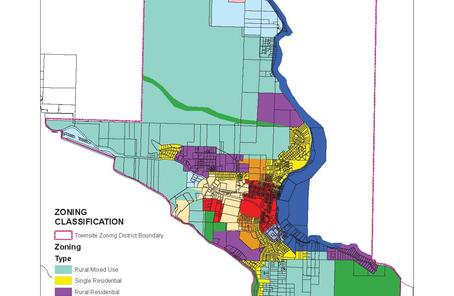
Related Questions
Any construction activities that change the footprint of the structure on your property within the townsite could be subject to permitting. Check the zoning use chart to identify whether you need to apply for a Land Use Permit or Conditional Use Permit.
Any new construction outside of the townsite service area that exceeds $5,000 in assessed value or 500 square feet in area must be declared on a Construction Declaration Form with no exception, regardless of which zone you are in. Certain types of uses outside of the townsite may also be subject to Conditional Use Permit requirements, including (but not limited to) landfills, heliports, communication facilities, and hazardous material storage.
Please note that the conditional use requirements and allowed uses vary greatly by zoning district, and different standards and review processes apply depending on the zone a permit is being sought for. For example, the General Use zone, outside the townsite, is the least restrictive zone in the Borough. Although some high impact uses in this zone require a permit, there are no prohibited uses in the General Use zone. Conversely, in the Mud Bay Rural Residential zone, things like heliports and commercial events are prohibited entirely. Please be sure to consult the Planning and Zoning Department with any questions.
Please check Haines Borough Code 18.80.030 Setback and Height Restrictions, linked here, for details on the setbacks imposed on your particular zone. Scroll down to find the chart with established setback distances and height restrictions.
Note that, generally, when more than one setback standard is applicable, the most restrictive setback standard applies.
In general, lots shall be designed with a reasonable proportion between width and depth. The standard minimum lot width shall be 65 feet. The lot depth shall be no less than 100 feet and no more than two and one-half times the lot width. Unless otherwise specified, no lot shall have an area smaller than 10,000 square feet. Existing lots established prior to the effective date of this code are not subject to these dimensional requirements.
Where lots are created that are less than 20,000 square feet in area, the commission shall require that the plat be so designated as to not allow for re-subdivision of such lots.
In the Mud Bay Rural Residential zone, there is a minimum 3-acre requirement for new lot sizes.
In the Rural Residential Zone, the minimum lot size is 1 acre. The minimum lot width shall be 200 feet. Any new lot less than one acre or lot line adjustment resulting in a lot of less than one acre shall not be allowed.
There is a five-step process for determining whether a Conditional Use Permit (CUP) may be granted.
- Before submitting an application, a person seeking a CUP will schedule a pre-application conference with the Borough Manager. The purpose of this meeting is for the applicant to explain their circumstances and for the manager to explain the CUP process and to indicate the types of information that will be necessary for the applicant to submit for Planning Commission review.
- Next, you will submit the Conditional Use Permit application along with the required fee of $150.00. Applications can be found here, or hard copies can be picked up at the Borough Admin building.
- After the initial meeting and review of the application packet to be sure it is complete, Borough staff will schedule the Conditional Use for review by the Planning Commission in a Public Hearing, and start the public notice process to notify your neighbors about your proposal.
- The next step is for you to attend the Planning Commission meeting where your proposal will be reviewed and decided upon. It is helpful for the Planning Commission if you are present and available to clarify or answer questions they raise.
- Finally, if the Planning Commission approves your application, the Borough Planning Department will issue your permit with the conditions imposed by the Commission.
- If the Planning Commission does not approve your application, there is an appeal process that allows an applicant to request that the Borough Assembly review the Planning Commissions decision. Any such appeal must be filed with the Borough Clerk within 10 business days of the denial. This process is spelled out in more detail in HBC 18.30.060.
The code most specific to Conditional Use Permit applications can be found in HBC 18.50.
There is a five-step process for determining whether a variance permit may be granted.
Although not required, it is highly recommended that a person seeking a variance schedule a pre-application conference with the Borough Manager. The purpose of this meeting is for the applicant to explain the situation that gives rise to the need for a variance and for the manager to explain the standards that must be met before a variance may be granted and to indicate the types of information that will be necessary for the applicant to submit for Planning Commission review.
- First, if desired, you will work with Planning and Zoning staff to schedule a pre-application meeting with the Borough Manager to explain the need for a variance and learn what information the Planning Commission will need in order to make a determination.
- Next, you must submit the Variance application along with the required fee of $150.00. Applications can be found here, or hard copies can be picked up at the Borough Admin building.
- After the initial meeting and review of your application packet to be sure it is complete, Borough staff will schedule the variance for review by the Planning Commission in a Public Hearing, and start the public notice process to notify your neighbors about your proposal.
- The next step is for you to attend the Planning Commission meeting where your proposal will be reviewed and decided upon. It is helpful for the Planning Commission if you are present and available to clarify or answer questions they raise.
- Finally, if the Planning Commission approves your application, the Borough Planning Department will issue your permit with the conditions imposed by the Commission.
- If the Planning Commission does not approve your application, there is an appeal process that allows an applicant to request that the Borough Assembly review the Planning Commissions decision. Any such appeal must be filed with the Borough Clerk within 10 business days of the denial. This process is spelled out in more detail in HBC 18.30.060.
The code most specific to Variance applications can be found in HBC 18.80.050.
The Haines Borough will never ask an individual to wire-transfer money for a permit or fee to be paid to the Borough. Please report any such request clerk [at] haines.ak.us (to the clerk.)